How to save money on fuel – 16 practical tips that work
Honest ways to cut what you spend on petrol and diesel, from comparing prices and judging detours to driving style, tyres and tracking your mpg.

There are only two ways to spend less on fuel: pay less for each litre, or use fewer litres. Most advice focuses on the second, but the first is often quicker. On 11 October 2026, most UK stations charged between 169.9p and 179.9p for unleaded petrol, a 10p spread that is worth £5 on a 50-litre fill.
The tips below are grouped into those two halves. None of them involve gadgets, and most cost nothing.
Part one: pay less for each litre
Around 47% of the price of petrol is fuel duty and VAT, and those are the same at every station. The rest varies, sometimes a lot, so where you buy matters.
1. Compare prices before you set off
Prices at stations in the same town can differ by 10p a litre or more. Under the government's Fuel Finder scheme, every UK filling station must report price changes within 30 minutes, so up-to-date prices are now available for the whole country.
PetrolNearby checks for new prices every 15 minutes and shows when each station last reported its price. A quick search near you before you leave home, or a look at prices by town before a journey, is the single easiest saving on this list.
2. Do not drive far to save a few pence
A cheaper station is only cheaper if the extra driving costs less than you save. The sum is simple:
Extra miles you can afford = (pence saved per litre × litres you buy) ÷ your cost per mile in pence
To find your cost per mile, divide the price per litre by the miles you get from each litre. A car that does 45 mpg covers about 9.9 miles per litre (there are 4.546 litres in a UK gallon). At around 175p a litre, that is roughly 17.7p a mile.
Here is a worked example. Your nearest station charges 176.9p, and one 4 miles away charges 171.9p, 5p cheaper. You need 40 litres.
- Saving at the pump: 5p × 40 litres = £2.00
- Extra driving: 4 miles there and 4 miles back = 8 miles × 17.7p = about £1.41
- Net saving: about 59p, before counting your time
If the cheaper station were 6 miles away, the 12-mile round trip would cost about £2.12, and you would lose money. The table below shows the most extra miles (there and back) that a saving can pay for, for the same 45 mpg car.
| Saving per litre | Buying 30 litres | Buying 50 litres |
|---|---|---|
| 2p | 60p, worth about 3.4 extra miles | £1.00, worth about 5.7 extra miles |
| 5p | £1.50, worth about 8.5 extra miles | £2.50, worth about 14.1 extra miles |
| 10p | £3.00, worth about 17 extra miles | £5.00, worth about 28 extra miles |
The best savings come from cheaper stations already on your route, such as one near work, the supermarket or the school run.
3. Avoid motorway services when you can
Motorway service areas are usually the most expensive places to fill up. In 2022 the Competition and Markets Authority (CMA) found drivers paid around 20p a litre more for petrol and 15p more for diesel there than elsewhere. If you are planning a long trip, fill up before you join the motorway, or come off at a junction with a town nearby. We explain why the gap exists in motorway fuel prices.
4. Buy the grade your car needs, not the one on offer
Super unleaded averaged about 17.5p a litre more than E10 on 11 October 2026, and premium diesel about 18.8p more than standard. If your car is designed for standard fuel, the premium grades are unlikely to pay for themselves. Our guides to E10 vs E5 petrol and premium diesel explain when they do make sense.
5. Use loyalty schemes and vouchers, but count them honestly
Supermarket fuel vouchers and loyalty points can knock a few pence off a litre. They are only a real saving if you would have spent the qualifying amount anyway. A 5p-a-litre voucher that requires you to spend £20 more on shopping than you planned is not a saving.
6. Keep an eye on the trend, but do not chase it
Prices respond to oil markets, exchange rates and refining margins, as explained in how UK fuel prices are set. When wholesale costs fall, some stations cut prices faster than others, so comparing matters most then. Our price charts and the UK fuel prices page show which way the national average is moving, and our look at UK fuel prices through history puts today's prices in context. Trying to time your fill-up to the day rarely beats simply choosing a cheaper station.
Part two: use fewer litres
How you drive and look after your car can make a bigger difference over a year than any single fill-up. The effect of each habit varies by car and journey, so treat these as directions rather than promises.
7. Drive smoothly and look ahead
Harsh acceleration and late braking waste fuel. Every time you brake hard, the energy you used to speed up is turned into heat. Looking further ahead lets you ease off early, roll towards hazards and red lights, and keep moving rather than stopping and starting.
Most modern cars cut fuel to the engine completely when you lift off the accelerator in gear, so coasting down to a junction in gear uses very little fuel.
8. Change up early
Engines are generally most efficient at moderate revs under a reasonable load. Changing up a gear early, without labouring the engine, usually saves fuel. Many cars have a gear shift indicator on the dashboard; following it is a good habit. In an automatic, gentle pressure on the accelerator lets the gearbox change up sooner.
9. Ease off on the motorway
Air resistance rises steeply with speed, so economy usually falls at higher motorway speeds. Dropping a few miles an hour on a long journey often makes a noticeable difference to fuel used, and adds only a few minutes. Steady speeds help too: on flat roads, cruise control can help you hold a constant pace.
10. Check your tyre pressures
Under-inflated tyres increase rolling resistance, so the engine works harder, and they wear faster and can affect handling. Check pressures at least once a month and before long trips, when the tyres are cold. The correct figures are in your handbook and often on a label inside the driver's door or fuel flap, sometimes with a higher setting for a fully loaded car.
11. Remove roof boxes, racks and unnecessary weight
A roof box or bike rack adds drag, especially at motorway speeds. If you are not using it, take it off. Extra weight matters most in stop-start driving, where the car has to accelerate that weight again and again, so clear out heavy items you do not need to carry around.
12. Be sensible with air conditioning
Air conditioning uses engine power, so it increases fuel use. Open windows add drag, which matters more as speed rises. A common rule of thumb is to open the windows at lower speeds around town and use the air conditioning on faster roads, but the difference either way is usually modest. Use the air conditioning whenever you need it to demist the windscreen or stay alert; safety comes first.
13. Cut out short trips and cold starts
An engine uses more fuel when it is cold, and the first few miles of any journey are the least efficient. A string of short trips, each from cold, can use far more fuel per mile than one longer trip.
Combine errands into one round trip so the engine stays warm, and walk or cycle for very short journeys if you can. There is no need to warm the engine up by idling; driving off gently warms it faster.
14. Switch off rather than idle
An idling engine does nothing useful while it burns fuel. The Highway Code (rule 123) says you must not leave a vehicle's engine running unnecessarily while it is stationary on a public road. If you are waiting for more than a minute or two, switch off. Many newer cars have stop-start systems that do this automatically.
15. Keep the car serviced
A car that is overdue for a service can use more fuel. Problems such as a clogged air filter, the wrong grade of engine oil, poorly aligned wheels or binding brakes all make the engine work harder. Follow the manufacturer's service schedule and get warning lights checked rather than ignoring them.
16. Track your mpg
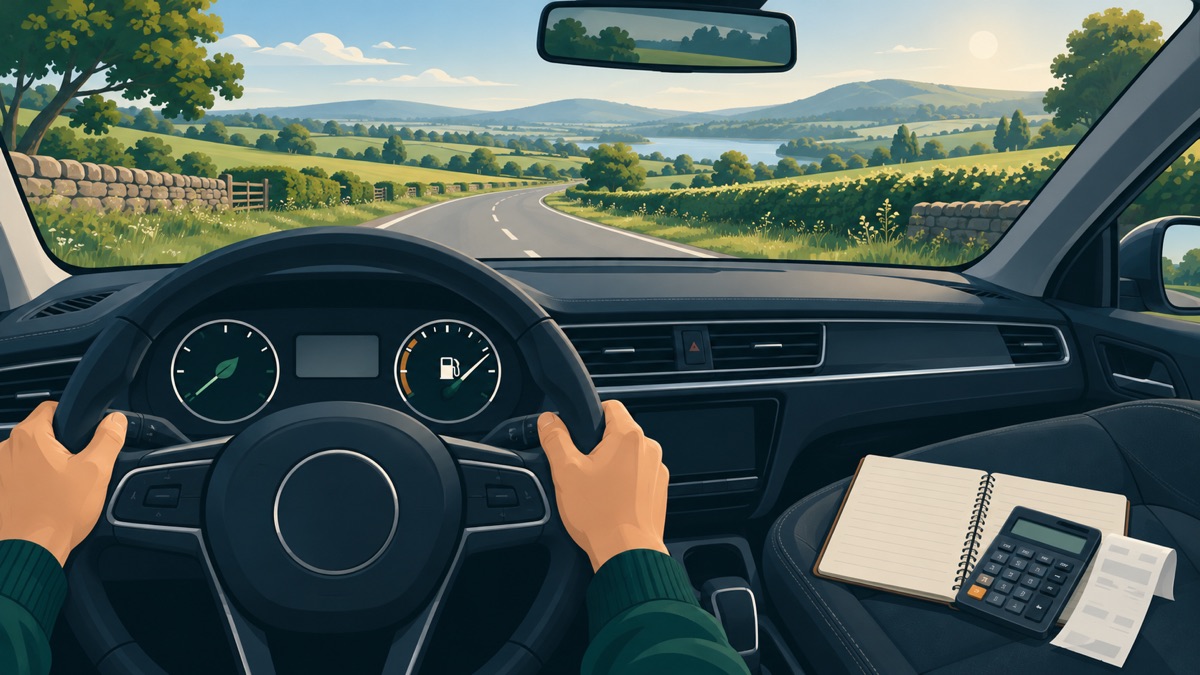
You cannot tell whether any of this is working unless you measure it. Record the litres and miles each time you fill up, and work out your mpg and cost per mile. Over a few months you will see which habits make a difference to your car, and notice early if economy suddenly drops, which can be a sign of a fault.
Our guide to calculating mpg and cost per mile explains the method, and the free PetrolNearby fuel logbook records each fill-up and does the sums for you.
Putting it together
Here is how the two halves compare for a typical driver covering 8,000 miles a year in a 45 mpg petrol car, which uses about 808 litres of fuel.
| Change | Effect | Rough annual saving |
|---|---|---|
| Buying at a station 5p cheaper on your usual route | 5p off each of 808 litres | about £40 |
| Buying at a station 10p cheaper on your usual route | 10p off each of 808 litres | about £81 |
| Using E10 instead of super unleaded, where suitable | about 17.5p off each litre | about £141 |
| Improving economy from 45 to 48 mpg through driving and maintenance | about 50 fewer litres at 174.7p | about £88 |
The economy figure is an illustration, not a promise. How much your own driving changes will depend on your car, your journeys and your starting habits. What the table does show is that choosing where you buy and what you buy can be worth as much as changing how you drive, and the best results come from doing both.
Frequently asked questions
Is it cheaper to fill the tank or buy a little at a time?
The price per litre is the same either way. Buying little and often lets you fill up when you pass a cheap station, but it means more stops. A full tank is heavier (a litre of petrol weighs about three quarters of a kilogram), but the effect on economy is small. Choose whichever lets you buy at the cheapest station on your normal routes.
Is it cheaper to fill up early in the morning?
The idea is that fuel is denser when it is cold, so you get more for your money. In practice, fuel is stored in underground tanks where its temperature stays fairly stable, so any effect is negligible. Finding a cheaper station saves far more.
Do fuel-saving gadgets and additives work?
Be sceptical of any device or bottle that promises big savings. A well-maintained car driven smoothly, with correctly inflated tyres, is already doing most of what is realistically possible. If a product claims a large improvement, look for independent evidence before you buy it.
Should I use cruise control to save fuel?
On flat motorways and dual carriageways, cruise control can help you hold a steady speed, which is efficient. On hilly roads it can be less economical, because it may accelerate hard to hold speed uphill where a driver would ease off slightly. Use it where the road is level and traffic is light.
How much could I realistically save by comparing prices?
It depends on how far apart prices are near you and how much fuel you buy. On 11 October 2026, the middle 80% of UK stations spanned about 10p a litre for unleaded and 9p for diesel. Saving 5p a litre on 50 litres is £2.50 a fill-up, or £62.50 over 25 fills a year, without driving any further.