How UK fuel prices are set, and where your money goes
What makes up the price of a litre of petrol or diesel in the UK, from wholesale costs and fuel duty to VAT and margins, and why nearby stations differ.
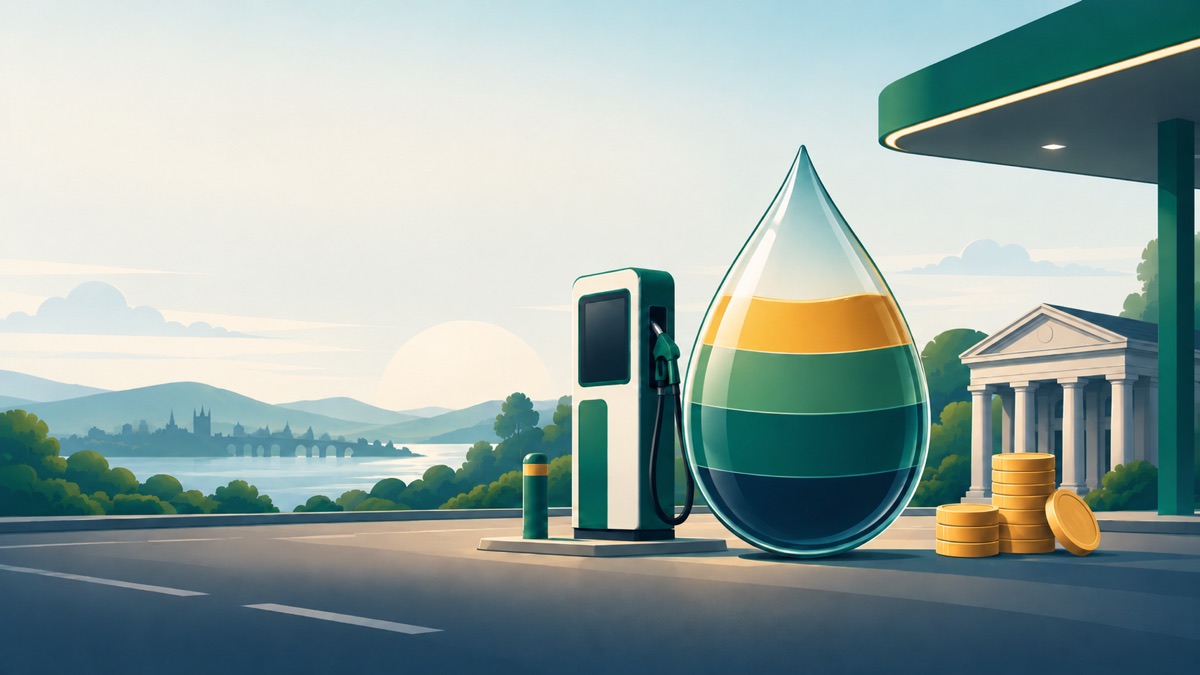
Almost half of what you pay for a litre of petrol goes straight to the Treasury. In the week of 5 October 2026, the government's weekly survey put the average price of unleaded petrol at 174.88p. Of that, 52.95p was fuel duty and about 29.15p was VAT, so roughly 47% of the pump price was tax.
The other half pays for the fuel itself, the cost of getting it to the forecourt and the retailer's share. Those are the parts that move from week to week, and they explain why two stations a mile apart can charge very different prices.
The parts of a pump price
Every litre sold at a UK filling station is made up of the same building blocks:
- The wholesale cost of the fuel. This is the price of refined petrol or diesel, which follows crude oil prices, refining margins and the pound–dollar exchange rate.
- The biofuel component. Standard petrol (E10) contains up to 10% bioethanol and standard diesel (B7) up to 7% biodiesel. Suppliers are required to supply renewable fuel, and its cost is built into the wholesale price.
- Fuel duty. A fixed amount per litre, currently 52.95p for both petrol and diesel.
- VAT. 20%, charged on everything above, including the duty.
- Delivery and the retailer's margin. The cost of storage, road tankers, staff, rent, card fees and the retailer's profit.
Here is how the average litre broke down in the week of 5 October 2026, using the government's weekly survey figures.
| Part of the price | Petrol (174.88p) | Share | Diesel (199.52p) | Share |
|---|---|---|---|---|
| Fuel duty | 52.95p | 30.3% | 52.95p | 26.5% |
| VAT at 20% | 29.15p | 16.7% | 33.25p | 16.7% |
| Fuel, biofuel, delivery and retail margin | 92.78p | 53.1% | 113.32p | 56.8% |
| Total tax | 82.10p | 46.9% | 86.20p | 43.2% |
Shares are rounded. Notice that VAT always takes the same share, one sixth of the pump price, while duty takes a smaller share as prices rise. That is why diesel, which was 24.64p dearer than petrol that week, carries a slightly lower proportion of tax.
The wholesale cost: crude oil, refining and the dollar
Crude oil is traded on world markets, and the price most often quoted for European fuel is the Brent benchmark. A car cannot run on crude, though. It has to be refined into petrol, diesel and other products, and those refined products have their own wholesale markets with their own prices.
The gap between the price of crude and the price of refined fuel is known as the refining spread. It can swing a lot. When the Competition and Markets Authority (CMA) reviewed the market in July 2022, it found the refining spread had more than tripled in a year, from about 10p to nearly 35p per litre. That, alongside rising crude prices, was the main reason pump prices hit records that summer.
Why the exchange rate matters
Oil and refined fuel are priced in US dollars. If the pound weakens against the dollar, UK buyers pay more for exactly the same cargo, even if the dollar price has not changed. A strong pound has the opposite effect. Currency moves rarely make headlines at the pump, but over a few months they can add or remove several pence a litre.
Why petrol and diesel go their separate ways
Before 2022, petrol and diesel prices tended to move together. Since then they have often diverged, and on 5 October 2026 diesel averaged 199.52p, a record high in the government series that started in 2003. Petrol, at 174.88p, was well below its own record of 191.55p set in the week of 4 July 2022.
Diesel is a different market. It powers lorries, vans, farm machinery and much of industry, and it competes for refinery output with heating oil and jet fuel. The UK relies heavily on imported diesel, so global supply disruptions tend to hit diesel prices harder than petrol. For more on how prices have moved over the years, see our guide to UK fuel prices through history or the full series on our UK fuel prices page.
Fuel duty: a fixed amount per litre
Fuel duty is charged per litre, not as a percentage. It has been 52.95p for both petrol and diesel since 23 March 2022, when it was cut by 5p from 57.95p, the rate that had applied since March 2011.
Because it is fixed, duty does not rise when oil gets more expensive. It does mean the pump price can never fall below a certain floor, however cheap crude becomes. When the CMA looked at the 2022 duty cut, it concluded that on the whole it had been passed on to drivers, with the largest retailers doing so immediately and others more gradually.
VAT: a tax charged on top of a tax
VAT at 20% is applied to the price including duty. That means drivers pay VAT on the duty itself: 20% of 52.95p is 10.59p. Before a single drop of fuel is paid for, every litre carries 63.54p of duty and VAT on that duty.
Two handy consequences follow from this:
- To find the VAT in any pump price, divide by six. At 174.88p, that gives 29.15p.
- Every 1p rise in the underlying cost adds 1.2p at the pump. If wholesale costs go up by 5p, drivers pay about 6p more, because VAT is added on top. The same applies in reverse when costs fall.
There is more detail, including how the rates have changed, in our explainer on fuel duty and VAT.
Delivery and the retailer's margin
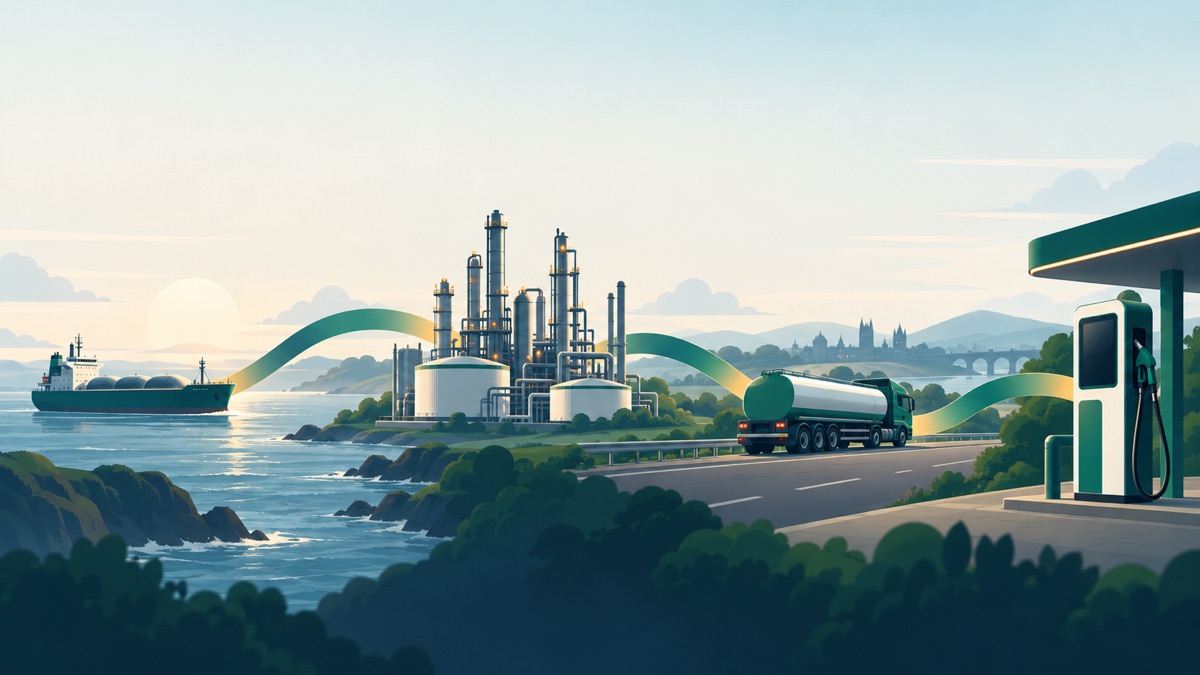
Once the fuel reaches an import terminal or refinery, it still has to be stored, loaded into road tankers and delivered to thousands of forecourts. A busy station in a town might take frequent large deliveries. A small rural station further from a terminal takes fewer, smaller loads, and each litre costs more to deliver.
The retailer then adds its margin. This covers running costs such as staff, rent, business rates, card payment fees, maintenance and pumps, and whatever is left is profit. In the CMA's analysis, the "retail spread" (the gap between the benchmark wholesale price and the pump price) averaged about 10p per litre in the year to July 2022, but it was much higher for diesel in early 2023, averaging 24.3p between January and May that year.
The CMA's final report in July 2023 concluded that competition between retailers had weakened since 2019. It found that average supermarket fuel margins had risen by 6p per litre between 2019 and 2022, and that the historic price leaders had raised their internal margin targets.
Why prices rise quickly and fall slowly
Drivers have long complained that pump prices shoot up like rockets when oil gets dearer but drift down like feathers when it gets cheaper. "Rockets and feathers" is a common phrase rather than a law of economics, and how much it happens varies from one period to another. Several explanations are often given:
- Stock timing. A retailer's tanks hold fuel bought at earlier prices. When costs rise, retailers price with the next, dearer delivery in mind. When costs fall, some are slow to cut while selling stock they paid more for.
- Nobody wants to go first. Cutting prices can start a local price war, so retailers may wait for competitors. When costs rise, everyone has a reason to pass them on quickly.
- Limited transparency. If drivers cannot easily see who has cut their prices, there is less pressure to cut.
There is official evidence that this happened at least some of the time. The CMA said in December 2022 that some generalised rocket and feather pricing patterns appeared to have emerged that year. Its final report found that one major supermarket chose in 2022 to reduce prices more slowly than before as wholesale prices fell, with other retailers following a similar path.
The CMA's main remedy was more transparency. It recommended a statutory open data scheme so drivers could compare prices in real time. That became the Fuel Finder scheme, under which UK filling stations must report price changes within 30 minutes. PetrolNearby checks for new prices every 15 minutes and shows when each station last reported its price.
Why stations a mile apart charge different prices
Duty and VAT are the same everywhere, and wholesale prices are broadly national. So most of the difference between two nearby stations comes down to the retailer's costs and pricing choices. Common reasons include:
- Local competition. The CMA found lower prices were typically associated with having a supermarket competitor nearby. A station with no close rival has less reason to price keenly.
- Business model. Supermarkets often use fuel to bring shoppers on site and sell in large volumes, which supports lower prices. We cover this in supermarket vs branded fuel.
- Location and costs. Rural and remote stations face higher delivery costs and sell less fuel to spread fixed costs over. Motorway service areas are a special case: in 2022 the CMA found drivers paid around 20p more for petrol and 15p more for diesel there. See why motorway fuel costs more.
- When the last delivery arrived. Two stations may be selling fuel bought at different wholesale prices.
- Pricing policy. Some retailers set prices centrally, others let individual sites or dealers price by reference to nearby competitors.
The spread is wide. On 11 October 2026, across the 7,737 stations selling E10 that PetrolNearby tracks, the cheapest price was 157.9p and the dearest 209.9p. Most stations (the middle 80%) charged between 169.9p and 179.9p. For diesel, the middle 80% ranged from 194.9p to 203.9p.
Regional differences are smaller than local ones
Regional averages vary by much less than individual stations do. Here are the E10 averages on 11 October 2026, compared with the UK average of 174.7p.
| Region | Average E10 price | Compared with UK average |
|---|---|---|
| Northern Ireland | 167.1p | 7.6p cheaper |
| North East | 173.7p | 1.0p cheaper |
| Yorkshire and the Humber | 173.8p | 0.9p cheaper |
| Wales | 174.0p | 0.7p cheaper |
| North West | 174.6p | 0.1p cheaper |
| London | 175.3p | 0.6p dearer |
| South West | 175.4p | 0.7p dearer |
| East Midlands | 175.4p | 0.7p dearer |
| East of England | 175.5p | 0.8p dearer |
| West Midlands | 175.6p | 0.9p dearer |
| Scotland | 175.8p | 1.1p dearer |
| South East | 176.3p | 1.6p dearer |
Northern Ireland stands out as the cheapest region for both fuels, with diesel averaging 192.7p against 201.2p in the South East and Scotland. Elsewhere in the UK, regional averages fall within about 2.6p of each other, while stations in the same town can differ by 10p or more. Where you fill up matters far more than which region you live in.
What this means when you fill up
You cannot change the 82p or so of tax in a litre of petrol, and you cannot do anything about the price of crude. The part you can influence is which station you buy from, and how much fuel you use.
On a 50-litre fill, a 10p per litre difference is £5. That is roughly the gap between a station at the cheaper end of the typical range and one at the dearer end. Checking prices before you set off, using the search near you or our prices by town, is the simplest way to capture it. If you want to see whether prices are heading up or down, our price charts show the national trend.
For more ideas, including when a detour is and is not worth it, read our guide on how to save money on fuel.
Frequently asked questions
How much of the price of petrol is tax?
In the week of 5 October 2026, about 47%. Petrol averaged 174.88p, of which 52.95p was fuel duty and about 29.15p was VAT. The proportion changes as prices move, because duty is a fixed amount per litre while VAT is always one sixth of the pump price.
Why is diesel more expensive than petrol?
The duty rate is the same for both, so the difference comes from the wholesale price and retail margins. Diesel is in high demand from haulage and industry, competes with heating oil and jet fuel for refinery output, and the UK imports a lot of it. In October 2026 diesel was about 24.6p a litre dearer than petrol on the government's weekly figures.
Does a fall in the oil price reach the pump straight away?
Not immediately. Retailers are often selling fuel bought days or weeks earlier, refining margins and exchange rates may move in the other direction, and some retailers are slower to cut than others. Over time, sustained falls in wholesale costs do feed through, but the timing varies by station.
Why do two stations of the same brand charge different prices?
Many branded forecourts are run by independent operators or dealer groups under a supply agreement, and they set their own prices based on local costs and competition. Even company-run sites are often priced with reference to nearby rivals, so one site next to a supermarket may be cheaper than another on a quiet road.
Will the government's price data make fuel cheaper?
It makes prices easier to compare. Under the Fuel Finder scheme, stations must report price changes within 30 minutes, and services like PetrolNearby turn that data into a searchable map. The CMA's argument was that when drivers can easily find the cheapest fuel, retailers have more reason to compete on price.