Fuel duty and VAT explained: how much of a litre is tax?
Fuel duty is 52.95p a litre and VAT adds 20% on top. See how much of the pump price is tax, with worked examples and duty rates since 2003.
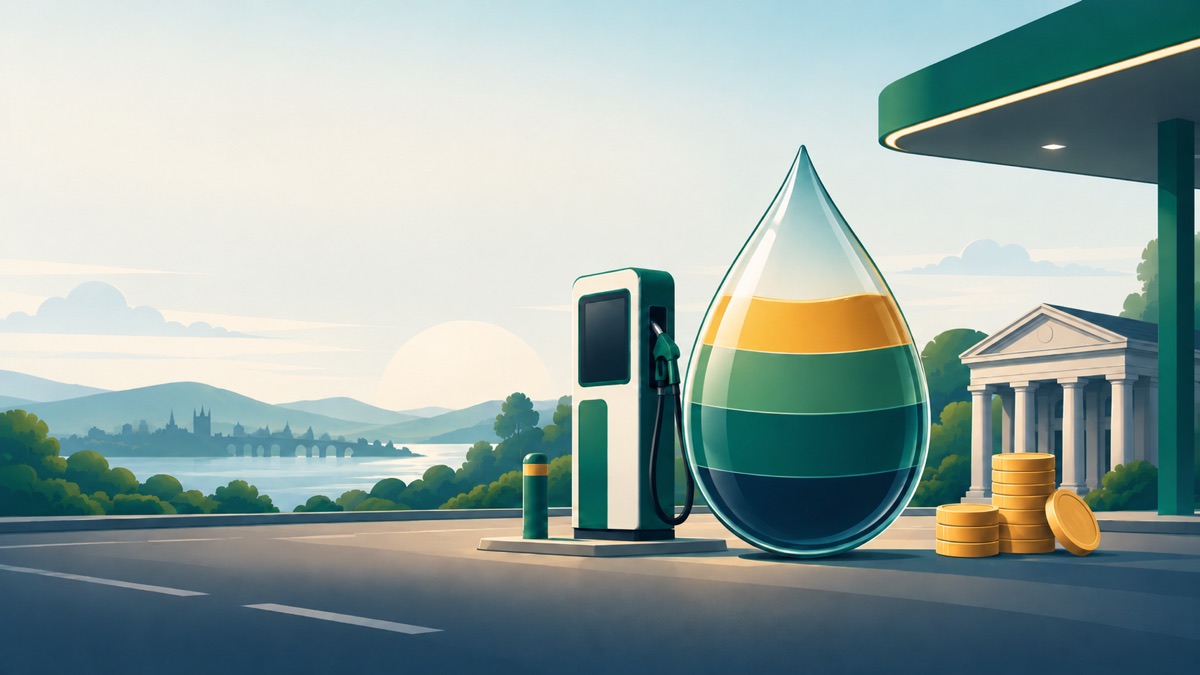
When you pay 174.7p for a litre of E10 petrol, the UK average on 11 October 2026, roughly 82p of it is tax. That is 52.95p of fuel duty plus about 29.12p of VAT, or close to 47% of the pump price. On a litre of diesel at the 199.8p average, the tax comes to about 86.25p, around 43%.
The two taxes work in very different ways. Fuel duty is a fixed amount per litre, while VAT is a percentage of the final price. Once you see how they fit together, you can work out the tax in any price on a forecourt sign, and understand why the tax share shrinks as prices climb.
The two taxes on every litre
Fuel duty: a fixed amount per litre
Fuel duty (formally, hydrocarbon oil duty) is charged at a flat rate per litre. Since 23 March 2022 the main rate for both petrol and diesel has been 52.95p per litre. Whether the pump says 140p or 200p, the duty in each litre is the same.
Duty is collected well before fuel reaches the pump. It becomes payable when fuel is released for sale from a duty-suspended site such as a refinery or bonded storage terminal, so it is already built into the price a filling station pays for its deliveries.
VAT: 20% of the duty-inclusive price
VAT at the standard rate of 20% is then charged on the full selling price, which already includes the duty. Because the price on the sign already includes VAT, the VAT element is not 20% of the pump price. It is one sixth of it.
The arithmetic is simple. If the price before VAT is X, the pump price is 1.2 × X and the VAT is 0.2 × X. Dividing 0.2 by 1.2 gives one sixth (20/120). So at 174.7p, the VAT is 174.7 ÷ 6 = 29.12p.
The "tax on a tax"
Because VAT is calculated on a price that already contains duty, part of the VAT you pay is VAT on the duty itself. At today's rate that is 52.95p × 20% = 10.59p in every litre.
This is often described as a "tax on a tax". It is not a special rule for fuel: VAT is normally charged on the full selling price of goods, including any excise duty, and the same happens with alcohol and tobacco. Whether that is fair is a matter of opinion. The mechanics are simply that VAT applies to the whole price.
How to work out the tax in any pump price
You only need the pump price and the duty rate. With petrol or diesel at 52.95p duty and VAT at 20%:
- Divide the pump price by 6 to get the VAT.
- Add 52.95p of duty to get the total tax per litre.
- Subtract the total tax from the pump price. What is left covers the fuel itself, delivery and the retailer's costs and margin.
- Divide the total tax by the pump price to get the tax share.
Take the week of 5 October 2026, when the government's weekly survey put average petrol at 174.88p. VAT was about 29.15p (174.88 × 20/120) and duty was 52.95p, so the tax came to about 82.10p. That left about 92.78p for the fuel and the retailer, and tax made up about 47% of the price.
Worked examples at different pump prices
Because duty is fixed and VAT is always one sixth of the pump price, the tax share depends entirely on how expensive the fuel is. Every row below uses 52.95p duty and 20% VAT, with real prices from PetrolNearby's 11 October 2026 snapshot where marked.
| Pump price | VAT (price ÷ 6) | Duty | Total tax | Left for fuel and retailer | Tax share |
|---|---|---|---|---|---|
| 130.0p | 21.67p | 52.95p | 74.62p | 55.38p | 57.4% |
| 150.0p | 25.00p | 52.95p | 77.95p | 72.05p | 52.0% |
| 157.9p (cheapest E10) | 26.32p | 52.95p | 79.27p | 78.63p | 50.2% |
| 174.7p (average E10) | 29.12p | 52.95p | 82.07p | 92.63p | 47.0% |
| 192.2p (average super unleaded) | 32.03p | 52.95p | 84.98p | 107.22p | 44.2% |
| 199.8p (average diesel) | 33.30p | 52.95p | 86.25p | 113.55p | 43.2% |
| 209.9p (dearest E10) | 34.98p | 52.95p | 87.93p | 121.97p | 41.9% |
Why the tax share falls as prices rise
Two things are going on. Duty stays at 52.95p however expensive fuel gets, so it becomes a smaller slice of a bigger price. VAT, meanwhile, is always 16.7% of the pump price. Add the two together and the tax share drifts down as prices go up, even though the amount of tax in pence keeps rising.
The table also shows why shopping around works. The gap between the cheapest and dearest E10 prices on 11 October was 52.0p a litre. Only about 8.7p of that was extra VAT; the other 43.3p or so had nothing to do with tax. Duty is identical at every forecourt, so almost all of the difference between stations comes from what each retailer charges for the fuel itself. You can compare prices near you on the PetrolNearby home page or browse prices by town.
Petrol and diesel pay the same duty
Unleaded petrol and diesel carry the same main duty rate, 52.95p per litre, and the same 20% VAT. That has been true throughout the period covered by the government's weekly price series, which starts in 2003.
So why is diesel dearer? On 11 October 2026 the average diesel price was 25.1p above E10. About 4.2p of that gap is extra VAT, because VAT rises with the price. The remaining 20.9p or so reflects the cost of the product and the retailer's margin, not tax. The reasons diesel costs more at wholesale level are covered in how UK fuel prices are set.
Premium grades work the same way. Super unleaded and premium diesel pay the same duty as standard fuel; you simply pay more VAT in pence because the price is higher. At the 218.6p average for premium diesel, VAT is about 36.43p and total tax about 89.38p, or roughly 41% of the price. If you are weighing up the extra cost, see E10 vs E5 petrol and is premium diesel worth it?.
Rebated "red" diesel carries a much lower rate, but it is only for permitted off-road uses and cannot legally be used in an ordinary road vehicle.
The same tax applies across the UK
Fuel duty and VAT are UK-wide taxes, charged at the same rates in England, Scotland, Wales and Northern Ireland. That makes regional price differences a useful clue to how much retailers' prices vary.
On 11 October 2026, Northern Ireland had the cheapest average E10 price at 167.1p and the South East the dearest at 176.3p, a gap of 9.2p. Only about 1.5p of that is VAT. The rest comes from differences in the price of the fuel, local competition and retailers' costs. The UK fuel prices page shows the latest averages by region.
A short history of fuel duty since 2003
The government's weekly road fuel price series, published by the Department for Energy Security and Net Zero, records the duty and VAT rates alongside pump prices. These are the changes since the series began in June 2003.
| Date | Duty per litre | VAT rate | What changed |
|---|---|---|---|
| June 2003 | 45.82p | 17.5% | Rate when the series begins |
| October 2003 | 47.10p | 17.5% | Duty increase |
| December 2006 | 48.35p | 17.5% | Duty increase |
| October 2007 | 50.35p | 17.5% | Duty increase |
| December 2008 | 52.35p | 15% | VAT temporarily cut to 15%; duty raised |
| April 2009 | 54.19p | 15% | Duty increase |
| September 2009 | 56.19p | 15% | Duty increase |
| January 2010 | 56.19p | 17.5% | VAT returns to 17.5% |
| April 2010 | 57.19p | 17.5% | Duty increase |
| October 2010 | 58.19p | 17.5% | Duty increase |
| January 2011 | 58.95p | 20% | Duty increase; VAT rises to 20% |
| March 2011 | 57.95p | 20% | Duty cut by 1p, then frozen |
| 23 March 2022 | 52.95p | 20% | 5p cut, still in place in October 2026 |
2003 to 2011: frequent rises
Between June 2003 and January 2011, duty rose from 45.82p to 58.95p, an increase of 13.13p or nearly 29%. Over the same period, VAT moved from 17.5% down to 15% for just over a year during the financial crisis, back to 17.5% in January 2010, and up to 20% in January 2011.
2011 to 2022: the long freeze
After the 1p cut in March 2011, duty stayed at 57.95p for 11 years. Pump prices moved a long way in that time, from a petrol average of 135.8p in 2012 down to lows around 101p in 2016 and back above 130p in 2021, but the duty in each litre did not change. That is why the tax share swung so much during the freeze: it was high when prices were low and lower when prices rose.
March 2022: the 5p cut
On 23 March 2022, duty was cut by 5p to 52.95p. It was originally announced as a temporary measure, but it has been kept in place at successive fiscal events and was still the rate in October 2026.
What the 5p cut means per litre and per tank
A 5p cut in duty also removes the VAT charged on that 5p, which is another 1p. So if the cut is passed on in full, it takes 6p off every litre.
| Fill-up size | Saving at 6p per litre |
|---|---|
| 40 litres (small car) | £2.40 |
| 50 litres | £3.00 |
| 55 litres | £3.30 |
| 60 litres | £3.60 |
| 70 litres | £4.20 |
| 80 litres (large SUV or van) | £4.80 |
For a driver using around 1,000 litres a year, that is about £60 a year compared with the old 57.95p rate.
Many drivers did not notice the cut at the time, because pump prices kept rising through the spring of 2022 and reached a record 191.55p for petrol in the week of 4 July 2022. The cut did not make fuel cheap; it meant prices were lower than they would otherwise have been, all else being equal. Retailers set their own pump prices, so how much of any duty change reaches the forecourt depends on the market. You can see how prices moved in our history of UK fuel prices.
How the tax share has changed over time
Applying the same method to past prices shows how the share of tax has moved with the price of fuel. These figures use yearly average petrol prices from the government series, with the duty and VAT rates in force throughout each year, so treat them as approximate.
| Period | Average petrol price | Duty | VAT rate | Approximate tax | Tax share |
|---|---|---|---|---|---|
| 2004 | 80.3p | 47.10p | 17.5% | 59.06p | 73.5% |
| 2012 | 135.8p | 57.95p | 20% | 80.58p | 59.3% |
| 2016 | 108.9p | 57.95p | 20% | 76.10p | 69.9% |
| 2019 | 125.0p | 57.95p | 20% | 78.78p | 63.0% |
| 2024 | 141.5p | 52.95p | 20% | 76.53p | 54.1% |
| Week of 5 Oct 2026 | 174.88p | 52.95p | 20% | 82.10p | 46.9% |
In 2004, nearly three quarters of the price of a litre was tax. Today it is under half, yet the tax in pence is higher than it was then. The share has fallen mainly because the untaxed part of the price, the fuel and the retailer's cut, has risen much faster than duty.
What fuel tax costs a typical driver in a year
Here is a worked example. A petrol car averaging 45 mpg over 10,000 miles a year uses about 1,010 litres of fuel (10,000 ÷ 45 × 4.54609).
- At 174.7p a litre, that fuel costs about £1,765.
- Fuel duty on 1,010 litres at 52.95p is about £535.
- VAT at one sixth of the price is about £294.
- Total tax: about £829, or roughly 47% of the year's fuel bill.
Your own figure depends on your mileage and economy. If you are not sure what your car really returns, how to calculate your mpg and cost per mile walks through it, and the free PetrolNearby logbook works it out from your fill-ups.
VAT-registered businesses can generally reclaim the VAT on fuel used for business, subject to HMRC's rules on private use. Fuel duty is not reclaimed in the same way, so it is a cost to everyone who buys road fuel.
Who sets the rates, and when they can change
Fuel duty and VAT rates are set by the Treasury and approved by Parliament. Changes are usually announced at a Budget or another fiscal statement, and they can take effect on the day of the announcement, as the March 2022 cut did, or from a later date.
This article does not try to predict what happens next. Duty has been raised, frozen and cut at different times since 2003, and future decisions depend on government policy. If a change is announced, the method above still works: swap in the new duty rate or VAT rate and redo the sums. You can follow how pump prices respond on the price charts.
What this means when you fill up
You cannot shop around for the tax in a litre: duty is the same 52.95p at every station, and VAT only varies because pump prices do. But choosing a cheaper station saves you the lower fuel price and the VAT on the difference as well. For ways to make that count, see how to save money on fuel and supermarket vs branded fuel.
Frequently asked questions
How much fuel duty is there on a litre of petrol?
The main rate is 52.95p per litre, and it has been since 23 March 2022. The same rate applies to diesel. On top of that you pay VAT at 20%, which at today's prices adds roughly another 29p to 33p per litre.
Is VAT charged on fuel duty?
Yes. VAT is charged on the full selling price, which includes duty, so about 10.59p of the VAT in each litre is VAT on the duty. This follows the general VAT rule that the tax applies to the whole price of goods, including any excise duty.
How do I work out the VAT in a pump price?
Divide the pump price by 6. At 174.7p a litre, the VAT is about 29.12p. This works because the pump price already includes 20% VAT, so the VAT is 20/120 of the total.
Why is the tax share lower when fuel is expensive?
Duty is a fixed amount in pence, so it becomes a smaller proportion of a higher price, while VAT stays at one sixth of the price. At 130p a litre tax is about 57% of the price; at 199.8p it is about 43%, even though more pence go to tax.
Do diesel drivers pay more tax than petrol drivers?
Per litre, diesel drivers pay the same duty but slightly more VAT, because diesel currently costs more. At the 11 October 2026 averages, a litre of diesel carried about 86.25p of tax against about 82.07p for E10. Diesel cars often travel further on each litre, so the tax per mile can be similar or lower.