Is supermarket fuel worse than branded fuel?
Supermarket petrol and diesel meet the same standards as branded fuel. What actually differs, why supermarkets are often cheaper, and how to compare.
No. Standard petrol and diesel from a supermarket forecourt are made to the same British Standards as fuel from BP, Shell, Esso or Texaco, and they work in exactly the same cars. What differs between retailers is mainly the blend of additives each one chooses, and the price.
That price difference is often the reason people ask. Supermarkets are frequently among the cheapest places to fill up, and it is natural to wonder whether something has been left out. In practice, the cheaper price usually reflects how supermarkets run their fuel business rather than what is in the tank.
Every forecourt sells fuel to the same standards
Petrol sold at UK filling stations is made to BS EN 228, the British Standard for unleaded petrol. Diesel is made to BS EN 590. These standards set out the properties the fuel must have, and key limits, such as sulphur content, are also fixed in law under the Motor Fuel (Composition and Content) Regulations.
The pump labels are the same wherever you go: a circle with E10 or E5 for petrol, and a square with B7 for diesel. If a supermarket pump says E10, the fuel meets the same specification as an E10 pump at a branded station.
| What is the same at every forecourt | What can differ between retailers |
|---|---|
| The standard the fuel is made to (BS EN 228 or BS EN 590) | The type and dose of additives |
| Minimum 95 octane for standard unleaded | Whether premium grades are sold |
| Up to 10% ethanol in E10, up to 7% biodiesel in B7 | The price per litre |
| Legal limits on sulphur and other properties | Loyalty schemes and vouchers |
| Seasonal summer and winter specifications | Facilities such as shops, toilets and car washes |
Where the fuel comes from
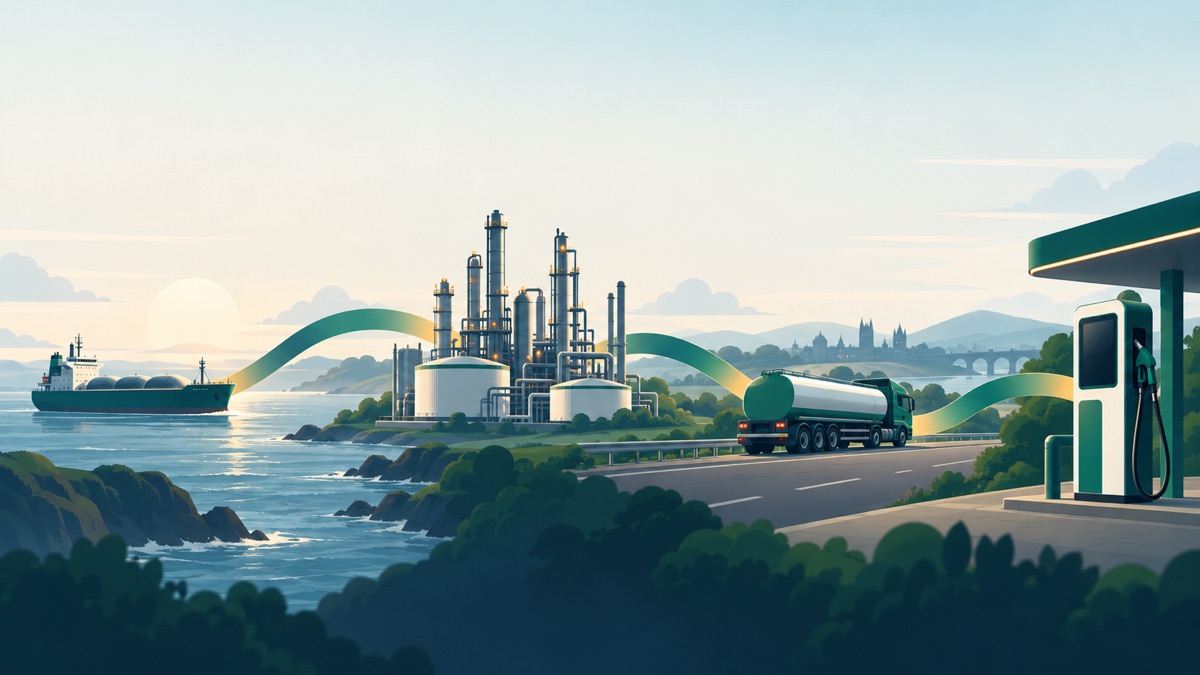
The UK's fuel supply chain is more shared than most people assume. Petrol and diesel come from refineries and import terminals, travel by pipeline, ship or road tanker to storage depots, and are then delivered to forecourts. Different retailers often draw from the same terminals.
Each retailer's own additive package is typically blended in when the fuel is loaded into the tanker. So the base fuel at a supermarket and at a branded station nearby may well have started in the same place, with the difference coming from the additives added at the end.
It is also worth knowing that many branded forecourts are not owned by the oil company whose logo is on the canopy. They are often run by independent operators or dealer groups under a supply and branding agreement, and those operators set their own prices.
What fuel additives do
Additives make up a tiny proportion of the fuel, but they are where brands compete on quality. Typical ingredients include:
- Detergents, which help stop deposits forming on fuel injectors and inlet valves
- Corrosion inhibitors, which protect metal parts of the fuel system
- Friction modifiers in some petrols, intended to reduce internal engine friction
- Anti-foam agents in diesel, which help the pump fill without frothing
- Cold-flow improvers in winter diesel, which help it flow in low temperatures
Standard fuel from most retailers contains some additives, including supermarket fuel. Branded companies tend to market their own additive technology more heavily, and their premium grades carry a stronger dose. We cannot verify individual brands' performance claims, and for most modern cars driven regularly, the difference between one retailer's standard fuel and another's is unlikely to be something you would notice.
If you are weighing up the premium grades, we cover them separately in E10 vs E5 petrol and is premium diesel worth it.
Why supermarket fuel is often cheaper
Supermarkets can price fuel keenly for reasons that have little to do with quality:
- Fuel brings shoppers on site. A driver who fills up may also buy groceries. Many supermarkets link fuel and shopping through loyalty points or money-off-fuel vouchers, so fuel helps the wider business.
- They sell large volumes. Supermarket forecourts are often big sites with many pumps and high turnover, which spreads fixed costs such as staff, equipment and rent across more litres.
- Their locations suit it. Supermarkets are usually in towns and retail parks with plenty of competition and passing trade, rather than on motorways or in remote areas where costs are higher.
- They have historically led on price. The Competition and Markets Authority (CMA) found that competition in fuel retail has generally been led by low-cost supermarkets setting the pace, with other retailers following. It also found that lower prices were typically associated with having a supermarket competitor nearby.
Cheaper is not guaranteed
Supermarket fuel is not always the cheapest. The CMA's 2023 report found that average supermarket fuel margins rose by 6p per litre between 2019 and 2022, and that the historic price leaders had become less aggressive on price. It also found that where a supermarket has no supermarket competitor nearby, it is likely to price by reference to more expensive non-supermarket rivals.
The CMA noted that supermarket margins were still lower than those of large non-supermarket retailers, but the gap had narrowed. The practical lesson is that the brand on the sign is a rough guide at best. An independent station across the road from a supermarket may match it, and a supermarket in a town with little competition may not be the cheapest option.
What the price data shows
Using the government's Fuel Finder data, PetrolNearby tracks prices at 8,131 UK stations. The spread between the cheapest and dearest is wide, even though the fuel meets the same standards everywhere.
On 11 October 2026:
| Fuel | UK average | Cheapest | Dearest | Middle 80% of stations |
|---|---|---|---|---|
| Unleaded petrol (E10) | 174.7p | 157.9p | 209.9p | 169.9p to 179.9p |
| Diesel (B7) | 199.8p | 168.9p | 234.9p | 194.9p to 203.9p |
The cheapest and dearest figures are outliers set by a handful of stations, and the dear end tends to be where competition is thin, such as motorway service areas and remote locations. The middle 80% is a better guide to what most drivers see: about a 10p spread for petrol and 9p for diesel. That is the difference between a keenly priced station and an expensive one in the normal range.
Here is what a price gap costs at the pump:
| Price difference | 40-litre fill | 50-litre fill | 60-litre fill |
|---|---|---|---|
| 3p a litre | £1.20 | £1.50 | £1.80 |
| 5p a litre | £2.00 | £2.50 | £3.00 |
| 10p a litre | £4.00 | £5.00 | £6.00 |
If you fill up 25 times a year, a 5p gap on 50 litres adds up to £62.50, and a 10p gap to £125. Over the same period, the difference in additives between one retailer's standard fuel and another's is very unlikely to be worth anything close to that.
How to compare stations sensibly
Choosing on price makes sense, as long as you compare like with like.
- Compare the grade you actually use. A station can be cheap for E10 and expensive for diesel. Search for your own fuel.
- Check how recent the price is. Under the Fuel Finder scheme, stations must report price changes within 30 minutes. PetrolNearby checks for new prices every 15 minutes and shows when each station last reported its price.
- Count the distance. Driving several miles out of your way can cancel out a small saving. Our guide on how to save money on fuel includes a simple way to work out whether a detour pays.
- Value vouchers honestly. A money-off-fuel voucher only saves money if you would have spent the qualifying amount anyway.
- Check the pump before you fill. Prices can change during the day, so glance at the price on the pump display before you start.
You can search near you on PetrolNearby to see every nearby station's price for your fuel, or look up prices by town if you are planning a journey.
Does branded fuel give better mpg?
Standard fuels from different retailers are made to the same standard, so their energy content is broadly similar. Any difference in economy between one retailer's standard E10 and another's is likely to be small, and much smaller than the effect of weather, traffic, tyre pressures and driving style.
If you want to find out for your own car, keep a record over several fill-ups at each retailer and compare cost per mile rather than how the car feels. Our guide to calculating mpg and cost per mile shows how, and the free fuel logbook does the arithmetic for you.
The bottom line
Supermarket fuel is not a lower grade of fuel. It meets the same standards, works in the same cars and comes through much the same supply chain. Branded companies sell fuel with their own additive packages and premium grades, which some drivers prefer, but for everyday standard petrol and diesel, price is a reasonable way to choose.
For a fuller picture of why prices differ so much from station to station, read how UK fuel prices are set. To see how the national average has moved over time, visit our UK fuel prices page or the price charts.
Frequently asked questions
Is supermarket diesel safe for modern diesel engines?
Yes. Supermarket diesel is made to BS EN 590, the same standard as branded diesel, and is suitable for any car designed to run on B7. Your handbook will say which grade your car needs, not which retailer.
Do supermarkets sell E10 and super unleaded?
Supermarket forecourts sell standard E10 like almost every other station. Many also sell a super unleaded grade, and some sell a higher-octane petrol under their own name. Check the grades listed for a particular station before you go.
Why does the same supermarket charge different prices at different branches?
Fuel is often priced locally. The CMA found that prices tend to be lower where there is more competition nearby, especially from another supermarket, and higher where there is little competition or costs are higher. Two branches of the same chain can therefore charge noticeably different prices.
What should I do if I think I have bought bad fuel?
Problems with contaminated fuel are uncommon and can happen at any brand. If your car runs badly straight after filling up, keep your receipt, tell the station, and get the car checked by a garage. You can also report concerns to your local Trading Standards service.
Can I mix supermarket and branded fuel in the same tank?
Yes. As long as it is the right type of fuel for your car, such as E10 petrol or B7 diesel, fuel from different retailers mixes without any problem.